| Native name | 运城市 |
|---|---|
| Coordinates | 35.0267°N 111.0070°E |
| Country | People's Republic of China |
| Province | Shanxi |
| County-level divisions | 13 |
| Municipal seat | Yanhu District |
| Communist Party Secretary | Wang Yuyan |
| Mayor | Wang Qingxian (王清宪) |
| Elevation | 370 m |
| Area total | 14183 km² |
| Area urban | 1205 km² |
| Area metro | 1205 km² |
| Population total | 4774508 |
| Population urban | 928334 |
| Population metro | 928334 |
| Prefecture-level city | CN¥ 164.4 billion US$ 25.8 billion |
| Per capita | CN¥ 34,425 US$ 5,508 |
| Postal code | 044000 |
| Area code | 0359 |
| Time zone | China Standard (UTC+8) |
| License Plate | 晋M |
| Administrative division code | 140800 |
| Iso code | CN-SX-08 |
| Population as of | 2020 census |
| Order | st |
|---|---|
| S | 运城 |
| T | 運城 |
| P | Yùnchéng |
| W | Yün-ch‘êng |
Yuncheng (traditional Chinese: 運城市; simplified Chinese: 运城) is the southernmost prefecture-level city in Shanxi province, People's Republic of China. It borders Linfen and Jincheng municipalities to the north and east, and Henan (Luoyang and Jiyuan to the east, Sanmenxia to the south) and Shaanxi (Weinan) provinces to the east, south and west, respectively. As of the 2020 census, its population was 4,774,508 inhabitants (5,134,779 in 2010), of whom 928,334 (680,036 in 2010) lived in the built-up (or metro) area made of Yanhu District. One can note than Pinglu County, 205,080 inhabitants in the south, is now part of Sanmenxia built-up (or metro) area.
Yuncheng is a city that was born and prospered from salt. It is named after the "City of Salt Luck".[1] The city is historically associated with the Yuncheng Salt Lake (运城盐湖), one of the largest natural salt lakes in China, which has been exploited for thousands of years and provided a crucial economic foundation for the region. In ancient times, the salt from Yuncheng was an important source of revenue and even influenced regional trade routes, making the city a strategic economic center. Due to its geographical location, Yuncheng also serves as a gateway connecting Shanxi with Henan and Shaanxi, making it an important transportation and cultural hub in the Yellow River basin.
The city is served by Yuncheng Yanhu International Airport, several national highways, and high-speed railway lines, which further strengthen its role as a regional transport node.
Name
Yuncheng was called the "Salt Family" in the Spring and Autumn Period. In the Han Dynasty, the salt city was named "Siyan City". Emperor Taizong of the Yuan Dynasty named Yuncheng Salt Lake "Shenghui Town" because it benefited the world. The city was built at the end of the Yuan Dynasty and was named "Phoenix City" was later renamed "Yuncheng" because of the "City of Salt Luck".[1]
History
Yuncheng is one of the important birthplaces of Chinese civilization. The legendary Chinese ancestors such as Nüwa, Lei Zu, Chi You, Shun, and Yu all were said to have lived here. It is even alleged that Yu established the Xia Dynasty here. During the Warring States Period, the Wei State established its capital here. This marked the beginning of dynastic history in China and laid the foundation for early state formation, making the region not only a political center but also a cultural hub influencing the Central Plains. Anyi, the capital of Wei, is located in Xia County, Yuncheng today.[2]
Hedong Salt Pond is the earliest salt pond developed and utilized in the world, with a mining history of more than 4,600 years. As an important strategic resource, salt ponds were the common goal of various tribes in the Central Plains of China in ancient China. From the ancient legend of the Yellow Emperor's battle with Chiyou, to the historical records of King Mu of Zhou, Emperor Cheng of Han, Emperor Zhang of Han, Emperor Taizong of Tang, Kangxi and other emperors visiting successively, the Hedong Salt Pond has been regarded as a "national treasure" by successive dynasties.[3] The salt pond not only supported the livelihoods of local people, but also served as a financial and military resource for dynasties.
In early China,[when?] it was the location of the state of Kunwu (昆吾). Yuncheng was the site of the Yuncheng Campaign (三打运城), battle between the Kuomintang army and the People's Liberation Army during Chinese civil war.
Yuncheng currently has 6,205 immovable cultural relics, 102 national key cultural relics protection units, and 55 wooden buildings before the Yuan Dynasty.[4]
Archaeology
In July 2022, archaeologists announced a discovery of a 2.8 cm long 5,200 years old stone carving chrysalis in a semi-crypt house at the Shangguo Site in Wenxi County. Archaeologists made suppositions that this house may have belonged to the Yangshao Culture period, based on the unearthed pottery pieces. According to archaeologist Tian Jianwen, the discovery of stone carving chrysalises provided significant information for the study of the silkworm culture in China.[5][6]
Administration
Yuncheng is located between 34°35′-35°49′ north latitude.[7] There are 13 county-level administrative divisions under Yuncheng's jurisdiction, including 1 district, 10 counties and 2 county-level cities. The Municipal executive, legislature and judiciary are in Yanhu District, together with the CPC and Public Security Bureau.
| Map | ||||||
|---|---|---|---|---|---|---|
| Name | Chinese | Hanyu Pinyin | Population (2010) | Area (km2) | Density (/km2) | |
| Yanhu District | 盐湖区 | Yánhú Qū | 680,036 | 1,237 | 501 | |
| Yongji City | 永济市 | Yǒngjì Shì | 444,724 | 1,221 | 352 | |
| Hejin City | 河津市 | Héjīn Shì | 395,527 | 593 | 607 | |
| Ruicheng County | 芮城县 | Ruìchéng Xiàn | 394,849 | 1,161 | 327 | |
| Linyi County | 临猗县 | Línyī Xiàn | 572,508 | 1,350 | 393 | |
| Wanrong County | 万荣县 | Wànróng Xiàn | 439,364 | 1,037 | 405 | |
| Xinjiang County | 新绛县 | Xīnjiàng Xiàn | 332,473 | 600 | 533 | |
| Xia County | 夏县 | Xià Xiàn | 352,821 | 1,328 | 264 | |
| Jishan County | 稷山县 | Jìshān Xiàn | 347,425 | 680 | 485 | |
| Wenxi County | 闻喜县 | Wénxǐ Xiàn | 404,150 | 1,160 | 328 | |
| Jiang County | 绛县 | Jiàng Xiàn | 281,643 | 968 | 279 | |
| Pinglu County | 平陆县 | Pínglù Xiàn | 258,241 | 1,151 | 217 | |
| Yuanqu County | 垣曲县 | Yuánqǔ Xiàn | 231,018 | 1,620 | 136 | |
Climate
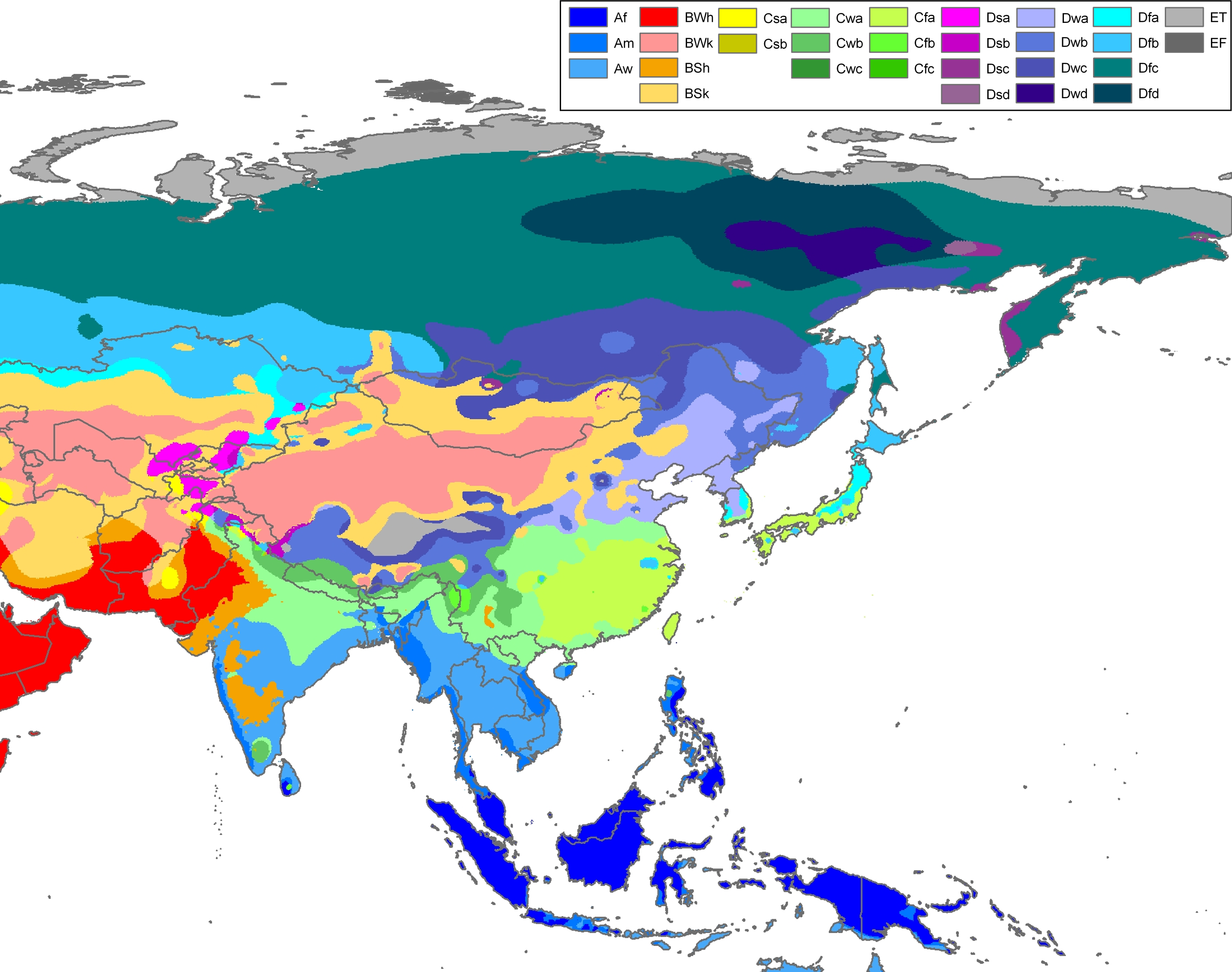
Yuncheng has a continental, monsoon-influenced semi-arid climate (Köppen BSk), with four distinct seasons.[8] Due to its southerly location and position to the north of the Zhongtiao Mountains, allowing for downsloping when winds are from the south, it is among the warmest locales in the province. Winters are cold and very dry, while summers are hot and humid. Monthly mean temperatures range from −0.6 °C (30.9 °F) in January to 27.5 °C (81.5 °F) in July, and the annual mean is 14.23 °C (57.6 °F). Over 60% of the annual rainfall occurs from June to September.The average frost-free period across the city is between 188 and 238 days.[7] With monthly percent possible sunshine ranging from 45% in March to 54% in May and July, the city receives 2,219 hours of bright sunshine annually, low by Shanxi standards and North China.
Notable people
- Guan Yu, general and deified historical figure
- Guan Hanqing, Dramatist
- Jing Haipeng, PLAAC astronaut
- Zhang Ziyi, Chinese zootechnician
- Gladys Aylward, British missionary who works in the city in the 1930s
Transportation
- Yuncheng Station Has a maximum daily passenger volume of 14,000[9]
- China National Highway 209
- G59 Hohhot–Beihai Expressway
- Datong–Xi'an Passenger Railway, with frequent service to Beijing, Taiyuan, and Xi'an.[10] Besides the Yuncheng North Railway Station (near Yuncheng's central city), the railway also has stations at Yongji and Wenxi.
- Yuncheng Yanhu International Airport (ICAO: ZBYC, IATA: YCU) is located on Guan Gong West Street in Taocun Town, Yancheng City, Shanxi Province, China.
See also
Notes and references
- ^ "千年盐运之城 运城的荣光与未来-新华网". www.news.cn. Retrieved 2024-12-15.
- ^ sina_mobile (2020-08-28). "运城的历史人文在山西最为丰富,名人辈出,可惜差一个5A级景区". k.sina.cn. Retrieved 2024-12-15.
- ^ "鉴往知来,跟着总书记学历史丨走进一座博物馆,寻根五千年中华文明" (in zh-cn). news.cctv.com. Retrieved 2024-12-15.
- ^ "书卷里的中国|山西运城何以成为华夏文明之源?". m.cnr.cn. Retrieved 2024-12-15.
- ^ "5,200-year-old stone carving chrysalis found in north China-Xinhua". www.chinaview.cn. Retrieved 2022-07-24.
- ^ Büyükyıldırım, Oğuz (2022-07-19). "5,200-year-old stone carving silkworm chrysalis discovered in north China". Arkeonews. Retrieved 2022-07-24.
- ^ "运城 - 气象数据 -中国天气网". www.weather.com.cn. Retrieved 2024-12-15.
- ^ "Updated Asian Map of the Köppen system.". wikimedia.org. Retrieved 5 April 2018.
- ^ "运城简介_稿件库_湖南红网新闻频道". news.rednet.cn. Retrieved 2024-12-15.
- ^ Yuncheng North schedule Archived 28 May 2015 at the Wayback Machine (in Chinese)