| Previous | Solar eclipse of September 12, 2034 |
|---|---|
| Next | Solar eclipse of September 2, 2035 |
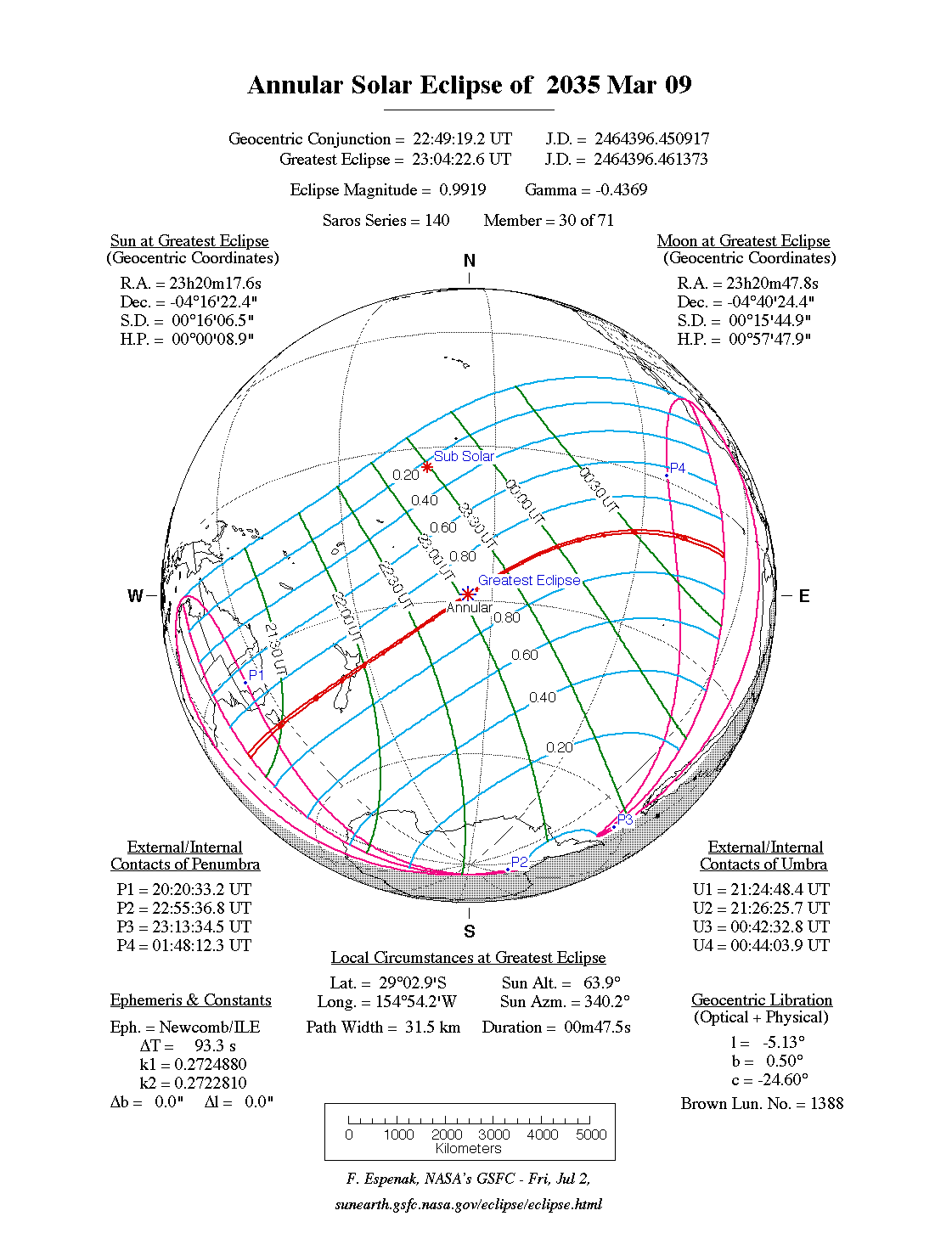
An annular solar eclipse will occur at the Moon's descending node of orbit between Friday, March 9 and Saturday, March 10, 2035,[1] with a magnitude of 0.9919. A solar eclipse occurs when the Moon passes between Earth and the Sun, thereby totally or partly obscuring the image of the Sun for a viewer on Earth. An annular solar eclipse occurs when the Moon's apparent diameter is smaller than the Sun's, blocking most of the Sun's light and causing the Sun to look like an annulus (ring). An annular eclipse appears as a partial eclipse over a region of the Earth thousands of kilometres wide. The Moon's apparent diameter will be near the average diameter because it will occur 7.6 days after apogee (on March 2, 2035, at 9:30 UTC) and 5.1 days before perigee (on March 15, 2035, at 1:40 UTC).[2]
Annularity will be visible for parts of New Zealand and French Polynesia. A partial eclipse will be visible for parts of Australia, Oceania, Antarctica, and central Mexico.
Images
Animated path
Eclipse timing
Places experiencing total eclipse
| Country or territory | City or place | Start of partial eclipse | Start of annular eclipse | Maximum eclipse | End of annular eclipse | End of partial eclipse | Duration of annularity (min:s) | Duration of eclipse (hr:min) | Maximum coverage |
|---|---|---|---|---|---|---|---|---|---|
| Richmond[a] | 09:34:43 | 10:51:55 | 10:52:27 | 10:52:59 | 12:18:01 | 1:04 | 2:43 | 97.50% | |
| Nelson[a] | 09:34:45 | 10:52:03 | 10:52:34 | 10:53:06 | 12:18:13 | 1:03 | 2:43 | 97.51% | |
| Paraparaumu[a] | 09:36:05 | 10:54:27 | 10:54:58 | 10:55:29 | 12:21:34 | 1:02 | 2:45 | 97.58% | |
| References: [1] | |||||||||
Places experiencing partial eclipse
| Country or territory | City or place | Start of partial eclipse | Maximum eclipse | End of partial eclipse | Duration of eclipse (hr:min) | Maximum coverage | |||
|---|---|---|---|---|---|---|---|---|---|
| Adelaide[a] | 07:09:53 (sunrise) | 07:50:20 | 08:55:40 | 1:46 | 65.53% | ||||
| Darwin[a] | 06:49:50 (sunrise) | 06:52:02 | 07:03:45 | 0:14 | 1.19% | ||||
| Brisbane[a] | 06:24:23 | 07:24:25 | 08:32:02 | 2:08 | 39.40% | ||||
| Melbourne[a] | 07:21:40 | 08:24:26 | 09:34:15 | 2:13 | 75.65% | ||||
| Canberra[a] | 07:21:16 | 08:24:58 | 09:36:17 | 2:15 | 66.65% | ||||
| Sydney[a] | 07:21:30 | 08:25:33 | 09:37:28 | 2:16 | 61.73% | ||||
| Nouméa[a] | 07:37:59 | 08:41:30 | 09:53:13 | 2:15 | 27.07% | ||||
| Kingston[a] | 08:30:46 | 09:43:05 | 11:04:56 | 2:34 | 50.62% | ||||
| Port Vila[a] | 07:50:11 | 08:46:49 | 09:49:59 | 2:00 | 15.11% | ||||
| Auckland[a] | 09:34:24 | 10:54:08 | 12:22:29 | 2:48 | 83.84% | ||||
| Wellington[a] | 09:36:05 | 10:54:42 | 12:20:59 | 2:45 | 97.49% | ||||
| Dumont d'Urville Station[a] | 07:03:06 | 07:54:49 | 08:48:36 | 1:46 | 31.50% | ||||
| Casey Station[a] | 06:00:30 (sunrise) | 06:05:59 | 06:42:39 | 0:42 | 26.51% | ||||
| Suva[a] | 08:59:05 | 10:10:24 | 11:28:43 | 2:30 | 23.88% | ||||
| Perth[a] | 06:12:20 (sunrise) | 06:14:12 | 06:15:33 | 0:03 | 0.36% | ||||
| Nuku'alofa[a] | 10:00:08 | 11:24:10 | 12:54:14 | 2:54 | 40.53% | ||||
| Funafuti[a] | 09:43:57 | 10:24:35 | 11:07:11 | 1:23 | 2.79% | ||||
| Mata Utu[a] | 09:21:46 | 10:31:53 | 11:45:58 | 2:24 | 16.79% | ||||
| Alofi | 10:12:55 | 11:41:37 | 13:13:05 | 3:00 | 41.82% | ||||
| Apia[a] | 10:25:26 | 11:44:27 | 13:05:51 | 2:40 | 23.86% | ||||
| Pago Pago | 10:25:25 | 11:46:56 | 13:10:24 | 2:45 | 26.61% | ||||
| Fakaofo[a] | 10:44:43 | 11:53:58 | 13:04:06 | 2:19 | 13.52% | ||||
| Rarotonga | 11:27:11 | 13:05:47 | 14:40:53 | 3:14 | 66.38% | ||||
| Papeete | 11:57:59 | 13:37:40 | 15:07:16 | 3:09 | 74.24% | ||||
| Kiritimati[a] | 12:55:42 | 13:54:00 | 14:48:22 | 1:53 | 8.25% | ||||
| Adamstown | 14:33:58 | 16:00:21 | 17:15:47 | 2:42 | 71.26% | ||||
| Galápagos Islands | 17:49:56 | 18:03:51 | 18:12:24 (sunset) | 0:22 | 11.64% | ||||
| Easter Island | 18:11:16 | 19:17:45 | 20:17:03 | 2:06 | 47.67% | ||||
| Mexico City | 18:23:43 | 18:42:10 | 18:44:28 (sunset) | 0:21 | 5.02% | ||||
| Clipperton Island | Clipperton Island | 16:01:24 | 16:55:07 | 17:27:34 (sunset) | 1:26 | 29.11% | |||
| References: [1] | |||||||||
Eclipse details
Shown below are two tables displaying details about this particular solar eclipse. The first table outlines times at which the Moon's penumbra or umbra attains the specific parameter, and the second table describes various other parameters pertaining to this eclipse.[3]
| Event | Time (UTC) |
|---|---|
| First Penumbral External Contact | 2035 March 9 at 20:22:04.1 UTC |
| First Umbral External Contact | 2035 March 9 at 21:26:19.2 UTC |
| First Central Line | 2035 March 9 at 21:27:07.8 UTC |
| Greatest Duration | 2035 March 9 at 21:27:07.8 UTC |
| First Umbral Internal Contact | 2035 March 9 at 21:27:56.5 UTC |
| Equatorial Conjunction | 2035 March 9 at 22:50:50.5 UTC |
| First Penumbral Internal Contact | 2035 March 9 at 22:57:05.1 UTC |
| Greatest Eclipse | 2035 March 9 at 23:05:53.6 UTC |
| Ecliptic Conjunction | 2035 March 9 at 23:10:39.6 UTC |
| Last Penumbral Internal Contact | 2035 March 9 at 23:15:08.3 UTC |
| Last Umbral Internal Contact | 2035 March 10 at 00:44:04.1 UTC |
| Last Central Line | 2035 March 10 at 00:44:49.7 UTC |
| Last Umbral External Contact | 2035 March 10 at 00:45:35.2 UTC |
| Last Penumbral External Contact | 2035 March 10 at 01:49:43.7 UTC |
| Parameter | Value |
|---|---|
| Eclipse Magnitude | 0.99191 |
| Eclipse Obscuration | 0.98388 |
| Gamma | −0.43679 |
| Sun Right Ascension | 23h20m17.6s |
| Sun Declination | -04°16'22.2" |
| Sun Semi-Diameter | 16'06.5" |
| Sun Equatorial Horizontal Parallax | 08.9" |
| Moon Right Ascension | 23h20m47.9s |
| Moon Declination | -04°40'23.8" |
| Moon Semi-Diameter | 15'44.9" |
| Moon Equatorial Horizontal Parallax | 0°57'47.9" |
| ΔT | 76.2 s |
Eclipse season
This eclipse is part of an eclipse season, a period, roughly every six months, when eclipses occur. Only two (or occasionally three) eclipse seasons occur each year, and each season lasts about 35 days and repeats just short of six months (173 days) later; thus two full eclipse seasons always occur each year. Either two or three eclipses happen each eclipse season. In the sequence below, each eclipse is separated by a fortnight.
| February 22 Ascending node (full moon) | March 9 Descending node (new moon) |
|---|---|
| Penumbral lunar eclipse Lunar Saros 114 | Annular solar eclipse Solar Saros 140 |
Related eclipses
Eclipses in 2035
- A penumbral lunar eclipse on February 22.
- An annular solar eclipse on March 9.
- A partial lunar eclipse on August 19.
- A total solar eclipse on September 2.
Metonic
- Preceded by: Solar eclipse of May 21, 2031
- Followed by: Solar eclipse of December 26, 2038
Tzolkinex
- Preceded by: Solar eclipse of January 26, 2028
- Followed by: Solar eclipse of April 20, 2042
Half-Saros
- Preceded by: Lunar eclipse of March 3, 2026
- Followed by: Lunar eclipse of March 13, 2044
Tritos
- Preceded by: Solar eclipse of April 8, 2024
- Followed by: Solar eclipse of February 5, 2046
Solar Saros 140
- Preceded by: Solar eclipse of February 26, 2017
- Followed by: Solar eclipse of March 20, 2053
Inex
- Preceded by: Solar eclipse of March 29, 2006
- Followed by: Solar eclipse of February 17, 2064
Triad
- Preceded by: Solar eclipse of May 9, 1948
- Followed by: Solar eclipse of January 8, 2122
Notes
- ^ The times listed for this location occur on March 10, 2035, local time.
References
- ^ "March 9–10, 2035 Annular Solar Eclipse". timeanddate. Retrieved 14 August 2024.
- ^ "Moon Distances for London, United Kingdom, England". timeanddate. Retrieved 14 August 2024.
- ^ "Annular Solar Eclipse of 2035 Mar 09". EclipseWise.com. Retrieved 14 August 2024.