| Previous | Solar eclipse of August 21, 2017 |
|---|---|
| Next | Solar eclipse of July 13, 2018 |
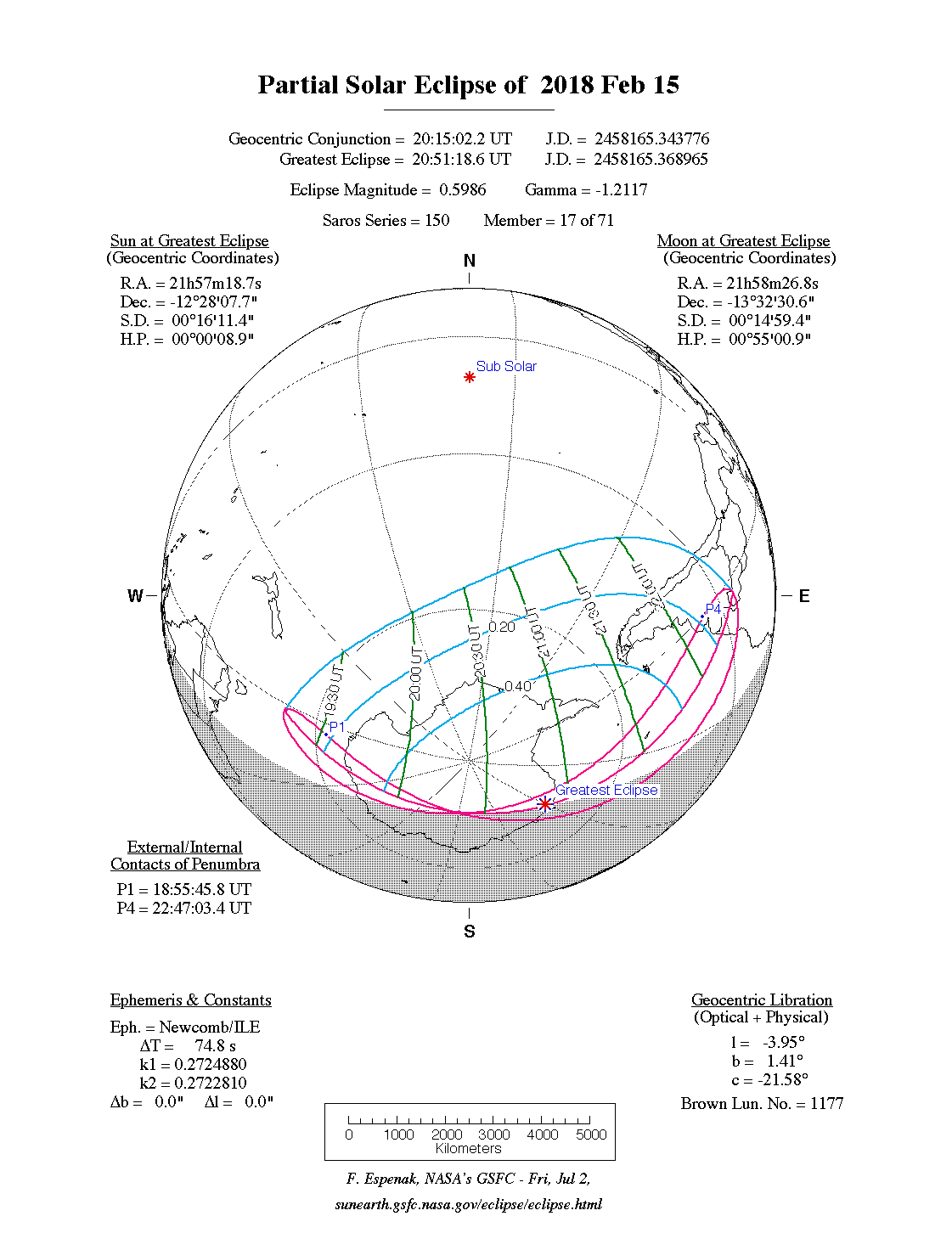
A partial solar eclipse occurred at the Moon's descending node of orbit on Thursday, February 15, 2018,[1][2][3][4] with a magnitude of 0.5991. A solar eclipse occurs when the Moon passes between Earth and the Sun, thereby totally or partly obscuring the image of the Sun for a viewer on Earth. A partial solar eclipse occurs in the polar regions of the Earth when the center of the Moon's shadow misses the Earth.
A partial eclipse was visible for parts of Antarctica and southern South America.
Eclipse timing
Places experiencing partial eclipse
| Country or territory | City or place | Start of partial eclipse | Maximum eclipse | End of partial eclipse | Duration of eclipse (hr:min) | Maximum coverage | |||
|---|---|---|---|---|---|---|---|---|---|
| Troll | 19:53:33 | 20:49:28 | 21:11:08 (sunset) | 1:18 | 49.09% | ||||
| Marambio Base | 17:15:47 | 18:16:37 | 19:14:15 | 1:58 | 37.98% | ||||
| Esperanza Base | 17:17:42 | 18:18:22 | 19:15:46 | 1:58 | 37.38% | ||||
| Carlini Base | 17:20:09 | 18:20:41 | 19:17:49 | 1:58 | 36.04% | ||||
| Orcadas Base | 17:24:53 | 18:23:21 | 19:18:41 | 1:54 | 39.94% | ||||
| King Edward Point | 18:38:36 | 19:33:13 | 19:57:49 (sunset) | 1:19 | 37.40% | ||||
| Punta Arenas | 17:40:59 | 18:37:49 | 19:30:47 | 1:50 | 22.90% | ||||
| Stanley | 17:46:42 | 18:42:18 | 19:34:14 | 1:48 | 27.69% | ||||
| Criciúma | 19:51:17 | 20:00:40 | 20:03:14 (sunset) | 0:12 | 1.53% | ||||
| Porto Alegre | 19:47:45 | 20:06:23 | 20:12:18 (sunset) | 0:25 | 3.68% | ||||
| Neuquén | 18:25:37 | 19:06:38 | 19:45:07 | 1:20 | 8.94% | ||||
| Mar del Plata | 18:25:06 | 19:07:07 | 19:46:36 | 1:23 | 12.10% | ||||
| Montevideo | 18:34:19 | 19:11:42 | 19:38:29 (sunset) | 1:04 | 8.83% | ||||
| La Plata | 18:35:10 | 19:12:11 | 19:45:33 (sunset) | 1:10 | 8.26% | ||||
| Canelones | 18:35:36 | 19:12:19 | 19:38:19 (sunset) | 1:03 | 8.35% | ||||
| Buenos Aires | 18:36:27 | 19:12:47 | 19:46:50 (sunset) | 1:10 | 7.76% | ||||
| Durazno | 18:39:36 | 19:14:08 | 19:37:44 (sunset) | 0:58 | 6.93% | ||||
| Rio Grande | 19:41:24 | 20:14:26 | 20:18:18 (sunset) | 0:37 | 6.64% | ||||
| Pelotas | 19:42:27 | 20:14:54 | 20:18:55 (sunset) | 0:36 | 6.27% | ||||
| Fray Bentos | 18:41:37 | 19:15:05 | 19:44:33 (sunset) | 1:03 | 6.09% | ||||
| Rosario | 18:43:43 | 19:15:57 | 19:46:35 | 1:03 | 5.18% | ||||
| Paysandú | 18:44:22 | 19:16:13 | 19:42:37 (sunset) | 0:58 | 5.28% | ||||
| Santiago | 18:49:25 | 19:16:26 | 19:42:15 | 0:53 | 2.45% | ||||
| Tacuarembó | 18:45:09 | 19:16:25 | 19:33:24 (sunset) | 0:48 | 5.23% | ||||
| Mendoza | 18:50:20 | 19:17:18 | 19:43:06 | 0:53 | 2.54% | ||||
| Rivera | 18:47:52 | 19:17:26 | 19:30:36 (sunset) | 0:43 | 4.47% | ||||
| Salto | 18:47:49 | 19:17:34 | 19:40:54 (sunset) | 0:53 | 4.34% | ||||
| Ciudad del Este | 19:13:34 | 19:18:02 | 19:20:31 (sunset) | 0:07 | 0.12% | ||||
| Córdoba | 18:52:50 | 19:19:08 | 19:44:19 | 0:51 | 2.63% | ||||
| Encarnación | 19:03:45 | 19:22:28 | 19:27:36 (sunset) | 0:24 | 1.14% | ||||
| References: [1] | |||||||||
Eclipse details
Shown below are two tables displaying details about this particular solar eclipse. The first table outlines times at which the Moon's penumbra or umbra attains the specific parameter, and the second table describes various other parameters pertaining to this eclipse.[5]
| Event | Time (UTC) |
|---|---|
| First Penumbral External Contact | 2018 February 15 at 18:56:59.4 UTC |
| Equatorial Conjunction | 2018 February 15 at 20:16:17.1 UTC |
| Greatest Eclipse | 2018 February 15 at 20:52:33.3 UTC |
| Ecliptic Conjunction | 2018 February 15 at 21:06:21.5 UTC |
| Last Penumbral External Contact | 2018 February 15 at 22:48:19.3 UTC |
| Parameter | Value |
|---|---|
| Eclipse Magnitude | 0.59911 |
| Eclipse Obscuration | 0.49084 |
| Gamma | −1.21163 |
| Sun Right Ascension | 21h57m18.8s |
| Sun Declination | -12°28'07.3" |
| Sun Semi-Diameter | 16'11.4" |
| Sun Equatorial Horizontal Parallax | 08.9" |
| Moon Right Ascension | 21h58m26.9s |
| Moon Declination | -13°32'29.9" |
| Moon Semi-Diameter | 14'59.4" |
| Moon Equatorial Horizontal Parallax | 0°55'00.9" |
| ΔT | 69.0 s |
Eclipse season
This eclipse is part of an eclipse season, a period, roughly every six months, when eclipses occur. Only two (or occasionally three) eclipse seasons occur each year, and each season lasts about 35 days and repeats just short of six months (173 days) later; thus two full eclipse seasons always occur each year. Either two or three eclipses happen each eclipse season. In the sequence below, each eclipse is separated by a fortnight.
| January 31 Ascending node (full moon) | February 15 Descending node (new moon) |
|---|---|
| Total lunar eclipse Lunar Saros 124 | Partial solar eclipse Solar Saros 150 |
Related eclipses
Eclipses in 2018
- A total lunar eclipse on January 31.
- A partial solar eclipse on February 15.
- A partial solar eclipse on July 13.
- A total lunar eclipse on July 27.
- A partial solar eclipse on August 11.
Metonic
- Preceded by: Solar eclipse of April 29, 2014
- Followed by: Solar eclipse of December 4, 2021
Tzolkinex
- Preceded by: Solar eclipse of January 4, 2011
- Followed by: Solar eclipse of March 29, 2025
Half-Saros
- Preceded by: Lunar eclipse of February 9, 2009
- Followed by: Lunar eclipse of February 20, 2027
Tritos
- Preceded by: Solar eclipse of March 19, 2007
- Followed by: Solar eclipse of January 14, 2029
Solar Saros 150
- Preceded by: Solar eclipse of February 5, 2000
- Followed by: Solar eclipse of February 27, 2036
Inex
- Preceded by: Solar eclipse of March 7, 1989
- Followed by: Solar eclipse of January 26, 2047
Triad
- Preceded by: Solar eclipse of April 18, 1931
- Followed by: Solar eclipse of December 17, 2104
References
- ^ "February 15, 2018 Partial Solar Eclipse". timeanddate. Retrieved 12 August 2024.
- ^ Rao, Joe (February 14, 2018). "Partial Solar Eclipse Occurs Thursday at the Bottom of the World". Space.com
- ^ "Partial Solar Eclipse 2018: All You Need To Know About The Celestial Event". NDTV.com
- ^ "This solar eclipse 2018 was seen by NASA from space!". India Today. 15 February 2018.
- ^ "Partial Solar Eclipse of 2018 Feb 15". EclipseWise.com. Retrieved 12 August 2024.
External links
- NASA chart
- NASA animation
- Partial Solar Eclipse of 2018 February 15[dead link]
- APOD 2/20/2018