| Previous | Solar eclipse of February 13, 1896 |
|---|---|
| Next | Solar eclipse of February 1, 1897 |
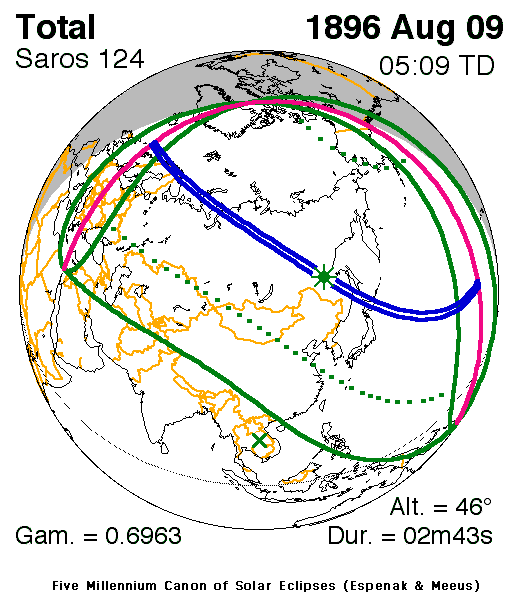
A total solar eclipse occurred at the Moon's descending node of orbit on Sunday, August 9, 1896, with a magnitude of 1.0392. A solar eclipse occurs when the Moon passes between Earth and the Sun, thereby totally or partly obscuring the image of the Sun for a viewer on Earth. A total solar eclipse occurs when the Moon's apparent diameter is larger than the Sun's, blocking all direct sunlight, turning day into darkness. Totality occurs in a narrow path across Earth's surface, with the partial solar eclipse visible over a surrounding region thousands of kilometres wide. Occurring about 2.5 days before perigee (on August 11, 1896, at 18:30 UTC), the Moon's apparent diameter was larger.[1]
The path of totality was visible from parts of northern Norway, northern Sweden, the Russian Empire, and the Empire of Japan. A partial solar eclipse was also visible for much of Europe, Central Asia, East Asia, Northeast Asia, Alaska, and Greenland.
This event was the subject of the first organized eclipse expedition by the British Astronomical Association. A group of 165 amateur and professional astronomers sailed from Tilbury, England on July 25, heading toward Vadsø, Norway.[2] This expedition failed to produce any usable results as they were frustrated by the weather conditions at the time of the eclipse.[3] However, a smaller expedition to Novaya Zemlya on Sir George Baden-Powell's yacht Otario met with success.[2]
Eclipse details
Shown below are two tables displaying details about this particular solar eclipse. The first table outlines times at which the Moon's penumbra or umbra attains the specific parameter, and the second table describes various other parameters pertaining to this eclipse.[4]
| Event | Time (UTC) |
|---|---|
| First Penumbral External Contact | 1896 August 9 at 02:43:20.8 UTC |
| First Umbral External Contact | 1896 August 9 at 03:52:06.8 UTC |
| First Central Line | 1896 August 9 at 03:53:08.3 UTC |
| First Umbral Internal Contact | 1896 August 9 at 03:54:10.1 UTC |
| Equatorial Conjunction | 1896 August 9 at 04:37:13.0 UTC |
| Ecliptic Conjunction | 1896 August 9 at 05:01:41.9 UTC |
| Greatest Duration | 1896 August 9 at 05:08:37.2 UTC |
| Greatest Eclipse | 1896 August 9 at 05:09:00.1 UTC |
| Last Umbral Internal Contact | 1896 August 9 at 06:24:07.8 UTC |
| Last Central Line | 1896 August 9 at 06:25:11.8 UTC |
| Last Umbral External Contact | 1896 August 9 at 06:26:15.3 UTC |
| Last Penumbral External Contact | 1896 August 9 at 07:34:47.9 UTC |
| Parameter | Value |
|---|---|
| Eclipse Magnitude | 1.03918 |
| Eclipse Obscuration | 1.07989 |
| Gamma | 0.69635 |
| Sun Right Ascension | 09h18m02.6s |
| Sun Declination | +15°44'00.4" |
| Sun Semi-Diameter | 15'46.9" |
| Sun Equatorial Horizontal Parallax | 08.7" |
| Moon Right Ascension | 09h19m10.6s |
| Moon Declination | +16°21'57.5" |
| Moon Semi-Diameter | 16'12.5" |
| Moon Equatorial Horizontal Parallax | 0°59'29.1" |
| ΔT | -5.8 s |
Eclipse season
This eclipse is part of an eclipse season, a period, roughly every six months, when eclipses occur. Only two (or occasionally three) eclipse seasons occur each year, and each season lasts about 35 days and repeats just short of six months (173 days) later; thus two full eclipse seasons always occur each year. Either two or three eclipses happen each eclipse season. In the sequence below, each eclipse is separated by a fortnight.
| August 9 Descending node (new moon) | August 23 Ascending node (full moon) |
|---|---|
| Total solar eclipse Solar Saros 124 | Partial lunar eclipse Lunar Saros 136 |
Related eclipses
Eclipses in 1896
- [Solar eclipse of February 13, 1896.
- February 1896 lunar eclipse.
- A total solar eclipse on August 9.
- August 1896 lunar eclipse.
Metonic
- Preceded by: Solar eclipse of October 20, 1892
- Followed by: Solar eclipse of May 28, 1900
Tzolkinex
- Preceded by: Solar eclipse of June 28, 1889
- Followed by: Solar eclipse of September 21, 1903
Half-Saros
- Preceded by: Lunar eclipse of August 3, 1887
- Followed by: Lunar eclipse of August 15, 1905
Tritos
- Preceded by: Solar eclipse of September 8, 1885
- Followed by: Solar eclipse of July 10, 1907
Solar Saros 124
- Preceded by: Solar eclipse of July 29, 1878
- Followed by: Solar eclipse of August 21, 1914
Inex
- Preceded by: Solar eclipse of August 29, 1867
- Followed by: Solar eclipse of July 20, 1925
Triad
- Preceded by: Solar eclipse of October 9, 1809
- Followed by: Solar eclipse of June 11, 1983
Solar eclipses of 1895–1899
The partial solar eclipses on March 26, 1895 and September 18, 1895 occur in the previous lunar year eclipse set, and the partial solar eclipse on December 13, 1898 occurs in the next lunar year eclipse set.
| Solar eclipse series sets from 1895 to 1899 | ||||||
|---|---|---|---|---|---|---|
| Descending node | Ascending node | |||||
| Saros | Map | Gamma | Saros | Map | Gamma | |
| 114 | August 20, 1895 Partial | 1.3911 | 119 | February 13, 1896 Annular | −0.9220 | |
| 124 | August 9, 1896 Total | 0.6964 | 129 | February 1, 1897 Annular | −0.1903 | |
| 134 | July 29, 1897 Annular | −0.0640 | 139 | January 22, 1898 Total | 0.5079 | |
| 144 | July 18, 1898 Annular | −0.8546 | 149 | January 11, 1899 Partial | 1.1558 | |
References
- ^ "Moon Distances for London, United Kingdom, England". timeanddate. Retrieved 27 August 2024.
- ^ Marriott, R. A. (June 1991). "Norway 1896: the BAA's first organised eclipse expedition". Journal of the British Astronomical Association. 101 (3): 162–170. Bibcode:1991JBAA..101..162M
- ^ "Expedition for the Observation of the Total Solar Eclipse, August 9th, 1896". Memoirs of the British Astronomical Association. 6: 1–4. 1898. Bibcode:1898MmBAA...6....1.
- ^ "Total Solar Eclipse of 1896 Aug 09". EclipseWise.com. Retrieved 27 August 2024.
External links
- NASA graphics
- Corona and Coronet: Being a narrative of the Amherst Eclipse Expedition to Japan, in Mr. James's Schooner-Yacht Coronet, to Observe the Sun's Total Obscuration, 9th August, 1896, by Mabel Loomis Todd, Houghton, Mifflin and Company, publishers, 1898
- Mabel Loomis Todd (1900). Total Eclipses of the Sun. Little, Brown.
- Solar eclipse of August 9, 1896 in Russia Archived August 9, 2009 at the Wayback Machine