| Standard | metric system |
|---|---|
| Quantity | pressure |
| Units 1 | SI units |
| Inunits 1 | 15 psi |
| Units 2 | CGS units |
| Units 3 | US customary units |
| Inunits 3 | 14.50377 psi |
| Units 4 | Atmospheres |
| Inunits 4 | 0.986923 atm |
The bar (symbol bar) is a metric unit of pressure defined as 100,000 Pa (100 kPa or 1000 hPa), though not part of the International System of Units (SI). A pressure of 1 bar is slightly less than the average atmospheric pressure on Earth at sea level (approximately 1.013 bar).[1][2] By the barometric formula, 1 bar is roughly the atmospheric pressure on Earth at an altitude of 111 metres at 15 °C.
The bar and the millibar (symbol mbar) were introduced by the Norwegian meteorologist Vilhelm Bjerknes, a founder of the modern practice of weather forecasting, with the bar defined as one megadyne per square centimetre.[3]
The SI brochure lists the symbol for the bar but does not otherwise mention the unit.[1] The bar has been legally recognised in countries of the European Union since 2004.[2] The US National Institute of Standards and Technology (NIST) deprecates its use except for "limited use in meteorology" and lists it as one of several units that "must not be introduced in fields where they are not presently used".[4] The International Astronomical Union (IAU) also lists it under "Non-SI units and symbols whose continued use is deprecated".[5]
Units derived from the bar include the megabar (symbol: Mbar), kilobar (symbol: kbar), decibar (symbol: dbar), centibar (symbol: cbar), and millibar (symbol: mbar).
Definition and conversion
The bar is defined using the SI derived unit, pascal: 1 bar ≡ 100,000 Pa ≡ 100,000 N/m2.
Thus, 1 bar is equal to:
- 1,000,000 Ba (barye; in CGS units (this has also been called "bar"[6][7]); and 1 bar is approximately equal to:
- 0.98692327 atm
- 14.503774 psi
- 29.529980 inHg
- 750.06158 mmHg
- 750.06158 mmHg
- 1,019.716 centimetres of water (cmH2O) (1 bar approximately corresponds to the gauge pressure of water at a depth of 10 metres)
1 millibar (mbar) is equal to:
- 0.001 bar
- 100 Pa
Origin
The word bar has its origin in the Ancient Greek word βάρος (baros), meaning weight. The unit's official symbol is bar;[citation needed] the earlier symbol b is deprecated and conflicts with the uses of b denoting the unit barn or bit, but it is still encountered, especially as mb (rather than the proper mbar) to denote the millibar. Between 1793 and 1795, the word bar was used for a unit of mass (equal to the modern tonne) in an early version of the metric system.[8]
Usage
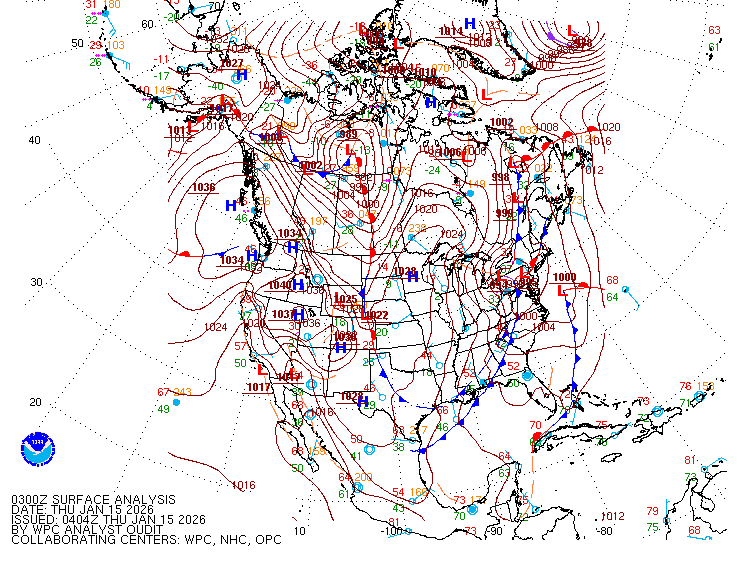
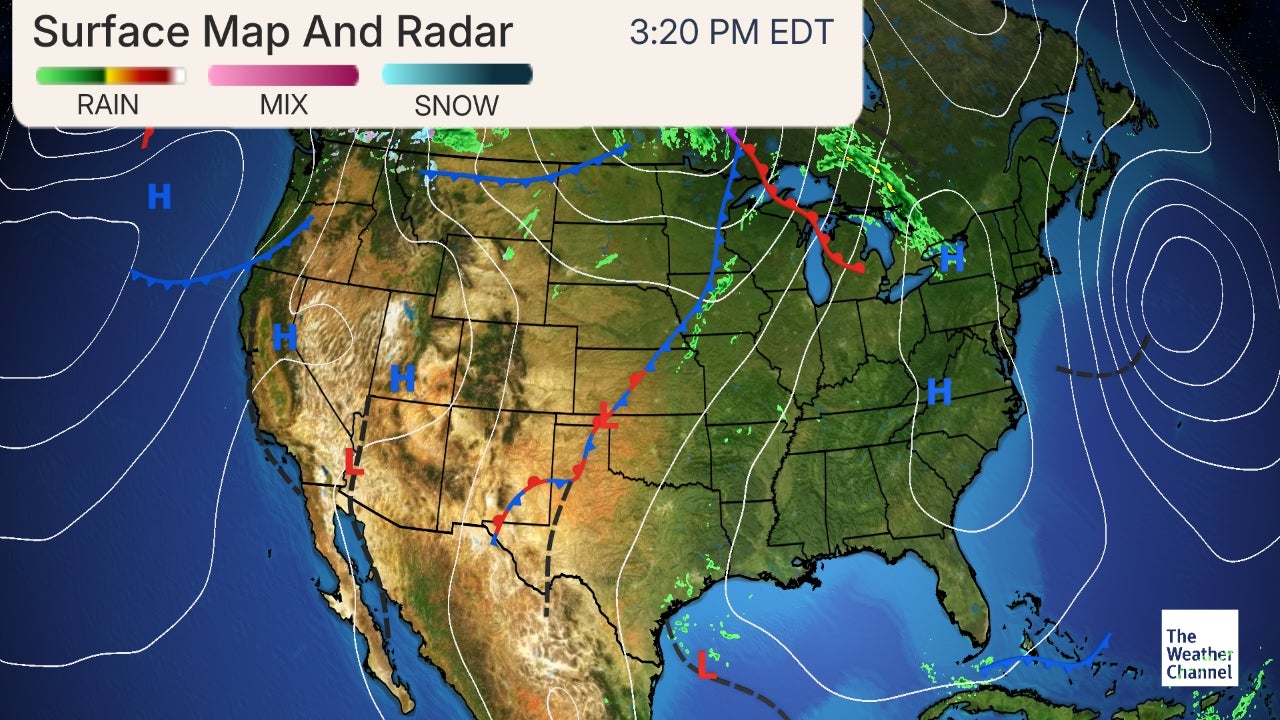
Atmospheric air pressure where standard atmospheric pressure is defined as 1013.25 mbar, 101.325 kPa, 1.01325 bar, which is about 14.7 pounds per square inch. Despite the millibar not being an SI unit, meteorologists and weather reporters worldwide have long measured air pressure in millibar as the values are convenient. Since the advent of SI units, some meteorologists began using hectopascals (symbol hPa) which are numerically equivalent to millibar; for the same reason, the hectopascal is the standard unit used to express barometric pressures in aviation in most countries. For example, the Meteorological Service of Canada uses kilopascals and hectopascals on their weather maps.[9][10] In contrast, Americans are familiar with the use of the millibar in US reports of hurricanes and other cyclonic storms.[11][12]
In fresh water, there is an approximate numerical equivalence between the change in pressure in decibar and the change in depth from the water surface in metres. Specifically, an increase of 1 decibar occurs for an increase in depth of 1.019716 m. In sea water with respect to the gravity variation, the latitude and the geopotential anomaly the pressure can be converted into metres' depth according to an empirical formula.[13] As a result, decibar is commonly used in oceanography.
In scuba diving, bar is also the most widely used unit to express pressure, e.g. 200 bar being a full standard scuba tank, and depth increments of 10 metre of seawater being equivalent to 1 bar of pressure.
Engineers commonly use the bar as a unit of pressure because using pascals would involve using very large numbers.[citation needed] In measurement of vacuum and in vacuum engineering, residual pressures are typically given in millibar, although torr or millimetre of mercury (mmHg) were historically common.[citation needed]
Pressures resulting from deflagrations are often expressed in units of bar.[14]
In the automotive field, turbocharger boost is often described in bar outside the United States. Tire pressure is often specified in bar. In hydraulic machinery components are rated to the maximum system oil pressure, which is typically in hundreds of bar. For example, 300 bar is common for industrial fixed machinery.
In the maritime ship industries, pressures in piping systems, such as cooling water systems, is often measured in bar.
Unicode has characters for "mb" (), "bar" () and ミリバール (; "millibar" spelt in katakana), but they exist only for compatibility with legacy Asian encodings and are not intended to be used in new documents.
The kilobar, equivalent to 100 MPa, is commonly used in geological systems, particularly in experimental petrology.
The abbreviations "bar(a)" and "bara" are sometimes used to indicate absolute pressures, and "bar(g)" and "barg" for gauge pressures. The usage is deprecated but still prevails in the oil industry (often by capitalized "BarG" and "BarA"). As gauge pressure is relative to the current ambient pressure, which may vary in absolute terms by about 50 mbar, "BarG" and "BarA" are not interconvertible. Fuller descriptions such as "gauge pressure of 2 bars" or "2-bar gauge" are recommended.[2][15]
See also
- Centimetre or millimetre of water
- Conversion of units § Pressure or mechanical stress
- List of metric units
- Metric prefix
- Orders of magnitude (pressure) § 100kPa
References
- ^ .
- ^ British Standard BS 350:2004 Conversion Factors for Units.
- ^ "Nomenclature of the unit of absolute pressure, Charles F. Marvin, 1918". noaa.gov. Archived from the original on 29 April 2017. Retrieved 6 May 2018.
- ^ NIST Special Publication 1038 Archived 2016-03-19 at the Wayback Machine, Sec. 4.3.2; NIST Special Publication 811, 2008 edition Archived 2016-06-03 at the Wayback Machine, Sec. 5.2
- ^ International Astronomical Union Style Manual. Comm. 5 in IAU Transactions XXB, 1989, Table 6
- ^ Allen, William H. (1965-01-01). "Dictionary of Technical Terms for Aerospace Use". NASA Special Publication
bar.... Some writers have used bar as equivalent to barye (1 dyne per square centimeter). ... barye.... Sometimes called bar or microbar.... microbar (abbr μb).... In British literature the term barye has been used.... Unfortunately, the bar was once used in acoustics to mean 1 dyne per square centimeter, but this is no longer correct.
- ^ Marvin, Charles F. (1918-03-30). "Nomenclature of the Unit of Absolute Pressure". Monthly Weather Review. 46 (2): 73–75. Bibcode:1918MWRv...46...73M. doi:10.1175/1520-0493(1918)46<73:NOTUOA>2.0.CO;2. Archived from the original on 2017-04-29.
T. W. Richards and A. E. Kennelly employed the term 'bar' to signify a pressure of 1 dyne per square centimeter
- ^ "Instructions abrégée sur les mesures déduites de la grandeur de la terre et sur les calculs relatifs à leur division décimale, 1793: gravet, bar". 1793. Archived 2023-01-15 at the Wayback Machine. Retrieved 2016-05-06.
- ^ Canada, Environment (2013-04-16). "Canadian Weather at a Glance - Environment Canada". www.weatheroffice.gc.ca. Archived 2 January 2018 at the Wayback Machine. Retrieved 6 May 2018.
- ^ Canada, Environment (2013-04-16). "Canadian Weather - Environment Canada". www.weatheroffice.gc.ca. Archived 2 January 2018 at the Wayback Machine. Retrieved 6 May 2018.
- ^ US government atmospheric pressure map
- ^ The Weather Channel
- ^ Fofonoff, N.P.; Millard, R.C.; Scientific Committee on Oceanic Research; SCOR. Working Group on Evaluation of CTD Data; Joint Panel on Oceanographic Tables and Standards (1983). Algorithms for computation of fundamental properties of seawater. UNESCO technical papers in marine science 44. p. 25. Archived 2015-04-12 at the Wayback Machine. Retrieved 2014-05-11.
- ^ NFPA 68 Standard on Explosion Protection by Deflagration Venting. 2023 ed.
- ^ "What do the letters 'g' and 'a' denote after a pressure unit? (FAQ - Pressure) : FAQs : Reference : National Physical Laboratory". Archived 7 April 2016 at the Wayback Machine. Retrieved 7 February 2016.