| Minorplanet | yes |
|---|---|
| Background |
|
| Discoverer | C. Shoemaker E. Shoemaker [a] |
| Discovery site | Palomar Obs. |
| Discovered | 11 October 1985 |
| Mpc name | (3793) Leonteus |
| Alt names | · 1961 TB · 1978 GO · 1986 XO |
| Adjective | Leontean, Leontian |
| Pronounced | /liːˈɒntiːəs/ |
| Named after | Leonteus[1] (Greek mythology) |
| Mp category | Jupiter trojan[1][2][3] Greek[4][5] · background[5] |
| Epoch | 23 March 2018 (JD 2458200.5) |
| Uncertainty | 0 |
| Observation arc | 56.62 yr (20,682 d) |
| Aphelion | 5.6801 AU |
| Perihelion | 4.7502 AU |
| Semimajor | 5.2151 AU |
| Eccentricity | 0.0891 |
| Period | 11.91 yr (4,350 d) |
| Mean anomaly | 194.79° |
| Mean motion | / day |
| Inclination | 20.902° |
| Asc node | 200.51° |
| Arg peri | 262.99° |
| Jupiter moid | 0.1261 AU |
| Tisserand | 2.8610 |
| Mean diameter | 86.26 ± 7.9 km[6] 86.38 km (derived)[3] 87.58 ± 2.53 km[7] 112.05 ± 1.85 km[8] |
| Rotation | 5.600 ± 0.004 h[9][b] 5.608 ± 0.01 h[10][b] 5.618 ± 0.0005 h[11] 5.62 ± 0.01 km[10][b] 5.6225 ± 0.0005 h[11] 11.22 ± 0.01 h[12] |
| Albedo | 0.042 ± 0.005[8] 0.070 ± 0.004[7] 0.0717 ± 0.015[6] 0.0784 (derived)[3] |
| Abs magnitude | 8.7[2][3] 8.80[6][7][8] |
3793 Leonteus /liːˈɒntiːəs/ is a large Jupiter trojan from the Greek camp, approximately 90 kilometers (56 miles) in diameter. It was discovered on 11 October 1985, by American astronomer couple Carolyn and Eugene Shoemaker at the Palomar Observatory in California, United States.[1][a] The D-type Jovian asteroid belongs to the 30 largest Jupiter trojans and has a rotation period of 5.6 hours.[3] It was named after the hero Leonteus from Greek mythology.[1]
Orbit and classification
Leonteus is a dark Jovian asteroid orbiting in the leading Greek camp at Jupiter's Lagrangian point, 60° ahead of its orbit in a 1:1 resonance (see Trojans in astronomy). It is also a non-family asteroid in the Jovian background population.[5]
It orbits the Sun at a distance of 4.8–5.7 AU once every 11 years and 11 months (4,350 days; semi-major axis of 5.22 AU). Its orbit has an eccentricity of 0.09 and an inclination of 21° with respect to the ecliptic.[2] The asteroid was first observed as ' at the McDonald Observatory in November 1951. The body's observation arc begins with its observation as ' at Goethe Link Observatory in October 1961, or 24 years prior to its official discovery observation at Palomar.[1]
Physical characteristics
In both the Tholen- and SMASS-like taxonomy of the Small Solar System Objects Spectroscopic Survey (S3OS2), Leonteus is a D-type asteroid.[13][14] It is also a D-type in the SDSS-based taxonomy,[15] while the Collaborative Asteroid Lightcurve Link (CALL) assumes it to be of carbonaceous composition.[3]
Rotation period
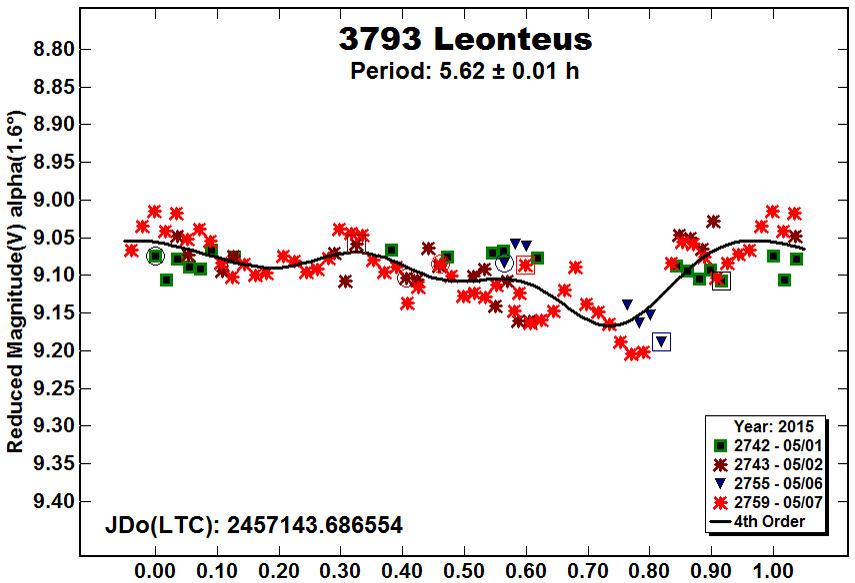
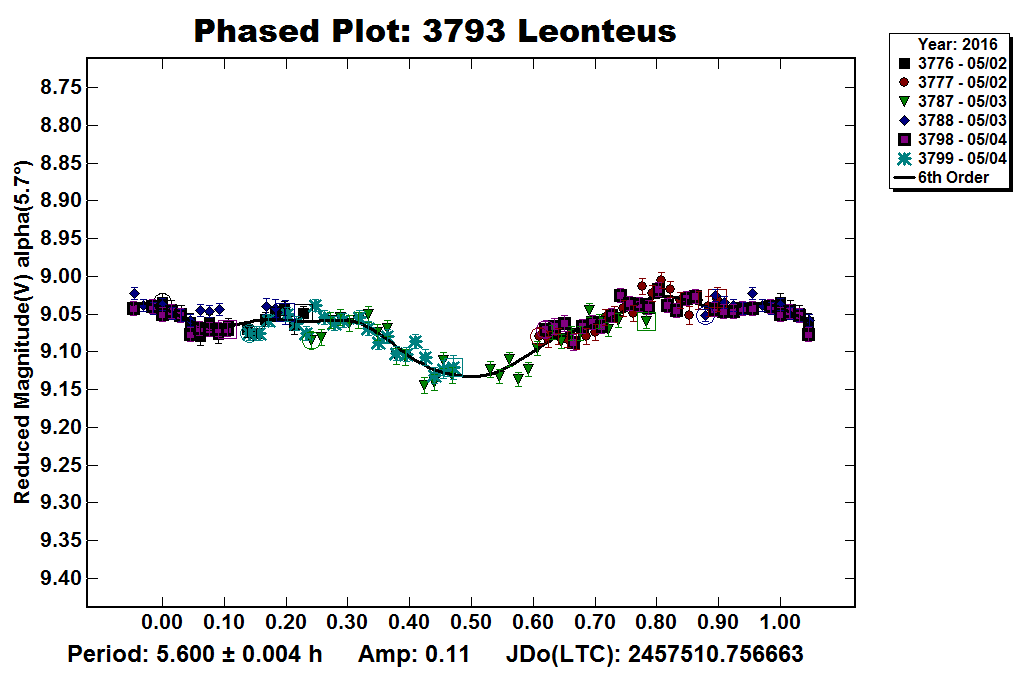
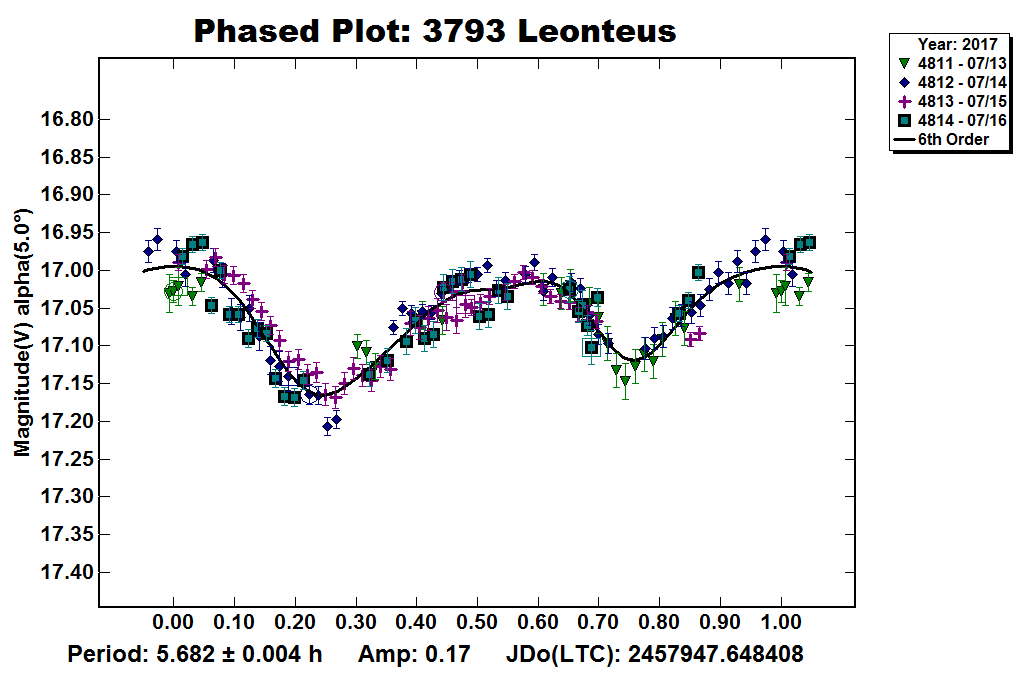
Since 1994, several rotational lightcurves have been obtained from photometric observations by Stefano Mottola and Anders Erikson using the Dutch 0.9-metre and Bochum 0.61-metre telescopes at La Silla Observatory in Chile, as well as by American photometrist Robert Stephens at the Center for Solar System Studies in California.[3][9][10][11][12][b]
Analysis of Mottola's best-rated lightcurve from June 1994 gave a rotation period of 5.6225 ± 0.0005 hours with a brightness variation of 0.24 ± 0.01 magnitude (U=2+).[3][11]
Diameter and albedo
According to the surveys carried out by the Infrared Astronomical Satellite IRAS, the Japanese Akari satellite and the NEOWISE mission of NASA's Wide-field Infrared Survey Explorer, Leonteus measures between 86.26 and 112.05 kilometers in diameter and its surface has an albedo between 0.042 and 0.072.[6][7][8]
CALL derives an albedo of 0.0784 and a diameter of 86.38 kilometers based on an absolute magnitude of 8.7.[3]
Naming
This minor planet was named from Greek mythology after Leonteus, a hero of the Trojan War, who attempted to win a competition among the Greek warriors to see who could throw an iron meteorite the farthest. However, he lost the game to his associate, Polypoites, after whom the minor planet 3709 Polypoites is named.[1] The official naming citation was published by the Minor Planet Center on 27 August 1988 (M.P.C. 13482).[16]
Notes
- ^ American astronomer Eugene Shoemaker, husband of Carolyn S. Shoemaker, is not credited with the discovery of this Trojan asteroid by the Minor Planet Center (MPC). He is, however, credited as a discoverer in the DISCOVERY.DB used on JPL's Small-Body Database Browser, which was last updated on 29 August 2003.
- ^ Lightcurve plots of (3793) Leonteus from May 2015, May 2016 and Jul 2017 by Robert Stephens at the Center for Solar System Studies . Quality code is 2-/3-/3 (lightcurve rating at CS3). Summary figures at the LCDB and CS3.
References
- ^ "3793 Leonteus (1985 TE3)". Minor Planet Center. Retrieved 9 June 2018.
- ^ "JPL Small-Body Database Browser: 3793 Leonteus (1985 TE3)" (2018-05-20 last obs.). Jet Propulsion Laboratory. Retrieved 9 June 2018.
- ^ No. 3793. Retrieved 9 June 2018.
- ^ "List of Jupiter Trojans". Minor Planet Center. 30 May 2018. Retrieved 9 June 2018.
- ^ "Asteroid (3793) Leonteus – Proper elements". AstDyS-2, Asteroids – Dynamic Site. Retrieved 9 June 2018.
- ^ Tedesco, E. F.; Noah, P. V.; Noah, M.; Price, S. D. (October 2004). "IRAS Minor Planet Survey V6.0". NASA Planetary Data System – IRAS-A-FPA-3-RDR-IMPS-V6.0. 12: IRAS-A-FPA-3-RDR-IMPS-V6.0. Bibcode:2004PDSS...12.....T. Retrieved 15 June 2018.
- ^ Usui, Fumihiko; Kuroda, Daisuke; Müller, Thomas G.; Hasegawa, Sunao; Ishiguro, Masateru; Ootsubo, Takafumi et al. (October 2011). "Asteroid Catalog Using Akari: AKARI/IRC Mid-Infrared Asteroid Survey". Publications of the Astronomical Society of Japan. 63 (5): 1117–1138. Bibcode:2011PASJ...63.1117U. doi:10.1093/pasj/63.5.1117 (online, AcuA catalog p. 153)
- ^ Grav, T.; Mainzer, A. K.; Bauer, J. M.; Masiero, J. R.; Nugent, C. R. (November 2012). "WISE/NEOWISE Observations of the Jovian Trojan Population: Taxonomy". The Astrophysical Journal. 759 (1): 10. arXiv:1209.1549. Bibcode:2012ApJ...759...49G. doi:10.1088/0004-637X/759/1/49. S2CID 119101711. Retrieved 9 June 2018. (online catalog)
- ^ Stephens, Robert D.; Coley, Daniel R.; Warner, Brian D.; French, Linda, M. (October 2016). "Lightcurves of Jovian Trojan Asteroids from the Center for Solar System Studies: L4 Greek Camp and Spies". The Minor Planet Bulletin. 43 (4): 323–331. Bibcode:2016MPBu...43..323S. ISSN 1052-8091. Retrieved 9 June 2018.
- ^ Stephens, Robert D.; Coley, Daniel, R.; French, Linda M. (January 2016). "Large L5 Jovian Trojan Asteroid Lightcurves from the Center for Solar System Studies". The Minor Planet Bulletin. 43 (1): 15–22. Bibcode:2016MPBu...43...15S. ISSN 1052-8091. Retrieved 9 June 2018.
- ^ Mottola, Stefano; Di Martino, Mario; Erikson, Anders; Gonano-Beurer, Maria; Carbognani, Albino; Carsenty, Uri et al. (May 2011). "Rotational Properties of Jupiter Trojans. I. Light Curves of 80 Objects". The Astronomical Journal. 141 (5): 32. Bibcode:2011AJ....141..170M. doi:10.1088/0004-6256/141/5/170
- ^ Stephens, Robert D. (April 2010). "Trojan Asteroids Observed from GMARS and Santana Observatories: 2009 October - December". The Minor Planet Bulletin. 37 (2): 47–48. Bibcode:2010MPBu...37...47S. ISSN 1052-8091. Retrieved 9 June 2018.
- ^ Lazzaro, D.; Angeli, C. A.; Carvano, J. M.; Mothé-Diniz, T.; Duffard, R.; Florczak, M. (November 2004). "S3OS2: the visible spectroscopic survey of 820 asteroids". Icarus. 172 (1): 179–220. Bibcode:2004Icar..172..179L. doi:10.1016/j.icarus.2004.06.006. Retrieved 9 June 2018.
- ^ "Asteroid 3793 Leonteus". Small Bodies Data Ferret. Retrieved 9 June 2018.
- ^ Carvano, J. M.; Hasselmann, P. H.; Lazzaro, D.; Mothé-Diniz, T. (February 2010). "SDSS-based taxonomic classification and orbital distribution of main belt asteroids". Astronomy and Astrophysics. 510: 12. Bibcode:2010A&A...510A..43C. doi:10.1051/0004-6361/200913322. Retrieved 30 October 2019. (PDS data set)
- ^ "MPC/MPO/MPS Archive". Minor Planet Center. Retrieved 9 June 2018.
External links
- Asteroid Lightcurve Database (LCDB), query form (info Archived 16 December 2017 at the Wayback Machine)
- Dictionary of Minor Planet Names, Google books
- Discovery Circumstances: Numbered Minor Planets (1)-(5000) – Minor Planet Center